
What you need to know about high-resolution sonar scanning in underwater bridge inspection
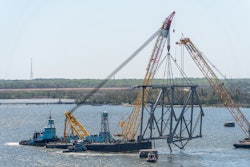
The waters of the Chesapeake Bay around the signature structure being investigated transition from a shallow depth of 19 feet to 100 feet deep near the navigation channels, with swift currents, heavy surface swells and near zero visibility underwater. Given this challenging and difficult environment, standard NBIS underwater inspections using visual and tactile methods are extremely difficult, time consuming and therefore very high in cost. Typically, the diver must maintain a stable position on portions of the pier to accurately identify, dimension, and locate defects in the pier surface while fighting swift current. Further, 16 of the piers are located in depths of 70 feet or deeper. OSHA requires a recompression chamber to be onsite for depths of 100 feet or deeper (OSHA 29 CFR 1910 Subpart T, 1910.425(b)(2)). This recompression chamber requirement is an additional cost in terms of equipment, personnel, and time; however, it is assumed that a chamber may not be necessary
for depths less than 100 feet.
Pennoni’s overall strategy to approach these challenges was a step by step effort of investigation, evaluation of results, and refinement of results. Starting with sonar system selection, the team investigated various technologies in use to determine the state-of-the-art system available. It was determined that the Kongsberg-Mesotech 1071 with a single exposed transducer provided the highest resolution with 675 Hz.
The next task was to obtain scans to determine if sonar could be used to identify target areas on a pier face. In addition, the team needed to determine the smallest dimension the system was capable of identifying within these target areas. The initial scans were performed on a pier in relatively shallow water (approximately 20 to 30 feet), in order to simplify the scanning and manage the subsequent target verification dive in a no-time-limit depth. During the scanning, several target areas were identified, including an apparent structural reinforcement of the web, a vertical object at the base of the east face of the diaphragm at the mudline, and a dark surface anomaly on the east face of the diaphragm.
These target areas were confirmed during the verification dive, as the diver was briefed with the sonar images and then was able to enter the water with a visual of the existing conditions. The target areas were found to be a previously undocumented steel channel section with dimensions of two to four inches, a pipe protruding from the mudline approximately two inches in diameter spaced approximately 20 feet east of the east diaphragm, and a change of about two inches in the thickness of marine growth.
Conclusions from this initial effort indicated that the sonar scans could indeed identify targets of interest, these targets were confirmed by diving, and the sonar was able to determine targets as small as two inches on the pier face.
During the scanning process in this relatively shallow depth with fairly calm sea conditions, the sonar readings and images were affected by wave motion as the transducer was suspended from the bow of the boat. Typically, the wave motion is translated into the sonar image and requires the sonar operator to rescan several times until satisfactory images are obtained. This led Pennoni to consider ways of improving the sonar image in future scanning efforts, as higher seas were more probable during operations at piers in deeper water and less-sheltered areas.
Since the sonar head in a boat-deployed scheme is subject to motion within six degrees of freedom, higher degrees of error were introduced into the image development. As one of the goals of the investigation was to establish methods of repeatability, it was important to consider ways to eliminate this systematic source of error.
Standard methods of sonar head placement are deployment from the structure via cable or pole, deployment from the boat via a spreader bar or the bow, or by using a tripod on the channel bottom. Because of the height of the bridge and traffic conditions, deployment from the bridge itself was not a viable option.
Deployment directly from the boat had already been seen to be susceptible to wave motion and thus was dependent on weather conditions.
MORE FROM eRoadPro Newsletter
MORE STORIES
POPULAR
COLUMNS
BLOGS
- Sydney uses water curtains to alert drivers to stop (VIDEO)806 Views
- Florida’s Red Light Camera Game: G R E E N orange R E D289 Views
- Big four cellphone companies jointly launch anti-texting campaign267 Views
- Acceptance of connected vehicles depends on cost, LaHood says265 Views
- Cities rethink transportation due to drop in young drivers260 Views