
Upgraded Infrared Asphalt Repair Technology Makes Short Work of Winter Potholes
Since the wider heating converter design generates more heat with better coverage, it also reduces the need for replacement parts used in typical asphalt infrared repair technology. With fewer replacement parts, the new design doubles the life expectancy of Kasi’s upgraded infrared heat chamber to over 10 years.
“Usually, contractors don’t realize anything is going to break until they’re in the middle of a job because equipment doesn’t break until you use it,” says Jimenez. “But downtime is killer. For us, the infrared upgrade is even more cost effective because there’s less wear and tear and less need for replacement parts. So we’re more productive with less downtime.”
Unlike traditional “saw, cut, and remove” or “crack filler” asphalt repair techniques, Kasi’s infrared asphalt repair has no seams for water and ice to penetrate. “It’s a more permanent patch that should last twice as long as remove and replace because water intrusion won’t be a factor,” says Jimenez. Instead, the infrared restorations fuse to the existing pavement, creating a continuous surface.
“Many municipalities I’ve worked for now have a no-cut law after I’ve proven they don’t have to saw cut new roads to place a utility line,” says Jimenez. “We get business on a municipality scale because they don’t want the mis-matched ‘saw cut’ look.”
The infrared repair’s continuous surface also eliminates the need for tack-coating the edges, enhances durability, and allows roads to be opened to traffic immediately. It makes the repair process less expensive, since existing asphalt is recycled, crew size is typically limited to two; and only a single truck or trailer is used.
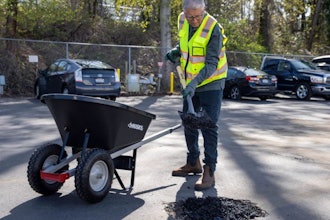
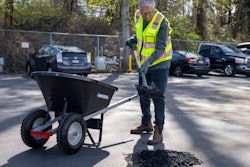
“With no saw cutting and jack hammering, no removing and replacing, no wait time for drying, our upgraded infrared asphalt repair equipment minimizes operating noise, downtime, and disruption,” says Jimenez. “We’re using 90% existing or recycled asphalt, and just one truck and two guys for less than 20 minutes on a typical 5’x5’ patch, instead of all new asphalt and typically three trucks and six guys for about three hours with traditional remove and replace repair.”
“With Kasi’s upgraded infrared asphalt repair equipment, we have about a 3-1 savings ratio in equipment, material, and labor over traditional remove and replace asphalt repair, so my bids are about 20% lower and my profit 30% higher the competition. “My business has doubled in two years, and referrals are 80% of my business.”
Kasi’s infrared asphalt repair equipment is commonly used by both public and private maintenance/transportation managers for asphalt repair of potholes, utility cuts, trenches, depressions, joints, and other irregular pavement issues. Lab studies show there is no change in asphalt integrity from the use of its infrared equipment.
The company offers a complete line of asphalt repair equipment worldwide including infrared heaters, asphalt reclaimers, asphalt rollers, rakes, brooms, shovels, and more.
For more info, or to view a step-by-step video of how the asphalt infrared repair process works, visit www.kasiinfrared.com; email info@kasiinfrared.com; or call 800-450-8602.
About the author: Del Williams is a technical writer based in Torrance, California.
MORE FROM Contributed Case Studies
MORE STORIES
POPULAR
COLUMNS
BLOGS
- Obama signs memorandum to expedite infrastructure projects666 Views
- Florida’s Red Light Camera Game: G R E E N orange R E D392 Views
- Sydney uses water curtains to alert drivers to stop (VIDEO)389 Views
- Seattle tests bikes as disaster relief (VIDEO)376 Views
- FHWA deploys bridge-inspecting robots296 Views