

Road Science: Secrets to Successful Milling

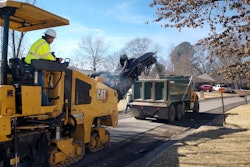
Las Vegas Paving owns its own fleet of trucks, so it was able to balance truck capacity and milling productivity without communications errors. The firm dedicated 20 sets of doubles – capable of holding up to 38 tons of millings each set – to the job. The crew kept a trailer underneath the mill’s 42-inch discharge conveyor belt. The larger PR950 mill was able to load a set of doubles in about four minutes, and another set always was ready, keeping the project going and on schedule to the point that the contractor met the May 1 completion deadline.

Another way of keeping a cold mill moving without stops is replenishing water (used to cool the teeth and suppress dust) “on-the-fly”, without stopping. While the mill moves forward, a water truck moves with the machine, filling its water tank.

The human element is a big part of productive milling, and keeping crews with a single machine over time will boost performance.

“It’s important that an owner keep his crew with a machine as long as he can,” Wirtgen’s Wiley said. When crews stay on a machine month after month, year after year, they understand it, they know what to do on the machine to keep it up and running, they have memory and records of any issues or problems with the machine. Having new crews all the time is not good for a milling operation. The best crews are those that have been with the machine for the life of the machine, as they treat it as their own.”

Posen Construction, Inc., Utica, Mich., knows the need to keep crews on one machine for heightened productivity and machine longevity. Posen recently purchased a half-lane BOMAG BM 2000/60 cold mill. Posen Construction primarily is a bridge building contractor, but is using the cold mill to expand its capabilities and diversify its customer base.

Posen makes sure it hires people who are equally dedicated to excellence and quality. Posen keeps an all-female crew – including a 21-year-old chief operator – to operate the BM 2000/60. Though it is unusual for an all-woman crew to run such a large piece of equipment, it’s the perfect arrangement, Posen maintains. They are often chosen to run Posen’s most expensive and complex machines, Mike Schook, vice president of Posen says. “They pay attention and they’re conscious of what they’re doing,” he says. “They take pride in the machine and keep it spotless.”

Wirtgen’s Wiley says it doesn’t matter how old a machine is, how many hours are on it, or what model it is. “What matters is the condition of the machine and how it’s been maintained,” Wiley points out. A good, well-maintained cutter system is crucial. Also, If a machine is ‘tight’ and not ‘loose’, every time the grade control calls for an adjustment, the milling machine will respond correctly and not create ups-and-downs due to the way its been maintained, he says.

Better Roads. “You have to plan the production for the day. You don’t want to go a quarter-mile, and then have to wait on trucks. Lining up the day’s work, and making sure you have enough trucks, is essential for a full day’s production. A machine will fill a truck up very fast these days, and any downtime is money just waiting to be claimed.” 

All about the cutter drum
The cutter drum is the axis around which the entire milling process revolves. A well-designed and well-maintained cutter drum will help the operator in his mission.

Aside from breakdowns, the proof of success will be in the cutter pattern. Variables in control of the cutter pattern include the condition of track pads, the cutter drum condition and tooth spacing, the cutter tooth and holder condition, the cutter rotation speed, the cutter “wrap” (tooth pattern on the drum) and tooth spacing, available grade control system, the existing pavement condition, the ground speed, the availability of water for dust control and tooth rotation, and the overall condition of the machine.

Milling pattern performance is so critical that the Colorado DOT has instigated a new milled surface spec that must be tested on the job for performance.

The spec determines the roughness of a milled pavement by placement of glass beads on a surface, which are then carefully spread out using a clear plastic disk. By the time the disk comes to rest on the peaks of the milled surface, the bead pile must have spread at least 9.5 inches in diameter, indicating a fine pattern; if they spill too quickly, not achieving the required diameter, the pavement is too rough and must be re-milled.

For the test, from a maximum 4-inches height, 200 milliliters of glass beads used for retroreflectivity of lane striping are poured onto the milled surface, then distributed evenly on the surface using a slow rotating motion with a plastic disk, until the disk rests on the points of the milled surface.

View Full Article
comments powered by Disqus
advertisement
advertisement
advertisement