
RoadScience

TRB researchers articulate means to process hog wastes from manure lagoons into bio-binder suitable for use with liquid asphalt in HMA or crack sealants.

The pavement design included 1.25-inch dowels, placed at the mid-depth of the full slab using dowel baskets, they say. Furthermore, the design included 0.5-inch tie bars to reinforce longitudinal joints, which the project contractor accommodated through the use of a tie-bar inserter attachment on the first paver.

One difference in the use of two pavers in PCC/PCC versus single-layer PCC is that the upper lift paver was adjusted to “crown” the lower lift slab by 0.75 inch on each side: that is, the second paver paved a lift 1.5 inches wider than the first paver in the train.

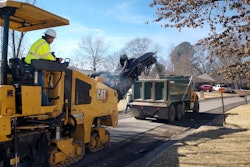
The only complications in the paving itself were those brought about by delays in the delivery of PCC for the two lifts. While the construction specifications indicated that paving of the second lift was to occur no later than 90 minutes after the first lift, on all three occasions of PCC/PCC paving at MnROAD the paving was frequently stalled for more than 90 minutes while waiting on batched upper lift PCC to arrive. Delivery delays led to 90- to 100-foot stretches of the placed lower lift being exposed to the environment for more than 120 minutes before the second lift was placed.

Concrete Issues

One of the most challenging aspects of the R21 PCC/PCC sections was the concrete itself. This challenge presented itself, they say, in: the development of a mix design that uses alternative materials and/or meets “low-cost” specifications; and the logistics behind batching and delivering concrete to meet the demands of the paving operations.

The most conventional of the three mixes was the EAC mix used for the upper lift, whereas the PCC used for the lower lifts presented challenges to the project in its use of high fractions of fly ash and/or RCA. The specification for up to 60 percent fly ash in the lower-lift PCC was inspired by the high fraction of SCM replacement in the new St. Anthony Falls (I-35W) bridge in Minneapolis, which used as much as 81-percent SCM replacement.

In New York State’s Catskill Mountains, an Ulster County road is cold-in-place recycled using foamed asphalt. New research indicates 11-year life extension for CIR pavements, even longer for high-level pavements with high annual average daily traffic.

As is the practice in Europe, the lower lift was viewed as an opportunity to use a lower-quality aggregate that would normally not be used for PCC paving. The team concluded that RCA was a viable coarse aggregate for the lower lift PCC — provided the RCA came from a known source, fines were excluded, and the stockpile was properly maintained (i.e., kept saturated to eliminate variable absorption as a concern).

The MnROAD R21 paving revealed a larger problem for the concrete in terms of consistency from batch to batch. “The challenge of providing a consistent batch from truck to truck was thought to be overcome after the demonstration slab,” the authors write. “However, paving on the mainline again suffered from the consistency problem, particularly in the case of the lower mixes, whose as-delivered slump oscillated between 0.25 and 2.75 inches (the target slump was 1 inch).”

Why the inconsistency? “The ready-mix supplier used by the contractor did not frequently design concretes using a large fraction of fly ash,” they say. “As a result, it is very possible that the ready-mix supplier’s inexperience in fly ash led to the mix designs being inadequately composed to handle such large amounts of this SCM (in terms of water demands, admixtures, so on).”

Furthermore, they write, the use of RCA required close attention. “The contractor had secured RCA of a known source and had washed the RCA of fines; however, the preparation of the RCA for batching – most notably, its degree of saturation – was not consistent,” they say. “One explanation of the inconsistency from batch to batch, as evident in the variable slump, is the inadequate maintenance of the RCA stockpile. It is possible that the stockpile had been allowed to dry.”

Problems aside, their overall impression was that PCC/PCC paving can be conducted in the United States using the existing infrastructure for conventional single-lift paving. “Furthermore, many of the complications in the construction were foreseen in the preliminary work leading up to construction: for instance, the challenge of the mix designs, the use of a single ready-mix batching plant, or the need to understand EAC brushing,” say Tompkins, Vancura, Rao, Khazanovich and Darter.

View Full Article

MORE ABOUT In the Magazine

comments powered by Disqus
advertisement
advertisement
advertisement