



RoadScience
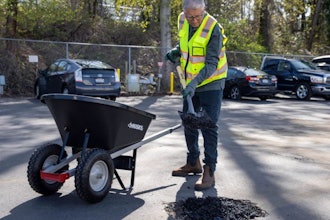
A competitive product is HP Asphalt Cold Patch from Crafco Inc. HP is approved as a high-performance patching material in most states, and other user agencies, within the United States, Crafco says. Like the UPM product, HP is specifically formulated for the wide-ranging temperatures and climates of its market areas. This permanent repair works in all weather conditions; wet, cold or hot, the maker says.
HP is supplied in bags, and no mixing, mechanical compaction or tacking is required. The material, Crafco says, permanently adheres to asphalt, concrete or steel, thus is applicable for bridge, drain, utility cuts and cutter work. The patch can be opened to traffic immediately, the manufacturer says.
Bonding Agents for Wet Conditions
If a lack of funds forces an agency to eschew proprietary mixes, and use conventional cold mix asphalt to patch potholes, it has the option of using a sprayed bonding or contact agent to ensure attachment to the wet substrate.
One such product is Bondade from Transpo Industries, Inc. Bondade is a solution which promotes adhesion of asphaltic materials to a variety of substrates. The coupling agents in Bondade markedly extend the working life of asphalt repairs by securing a firm, water-insensitive bond between repair asphalt and the base materials, Transpo says. “Bondade should be used whenever new asphalt or bituminous concrete is applied to either concrete, asphaltic surfaces or potholes,” the maker adds.
This bond will last up to 85 percent longer than conventional methods, the maker says. It’s an environmentally-safe “green” product, which is non-toxic, non-flammable and non-combustible, and contains no volatile organic compounds. It’s indicated for hot and cold patch repairs, damp or dry holes, overlays, cold joints between lanes of HMA, and emergency repairs, Transpo says.
Spray-Injection Uses Crew of One
A step up from the truck-and-crew methods are the self-propelled units. The spray-injection patching process using a mobile unit reduces personnel used to one worker. For example, with the Rosco RA-300 unit from VT Lee-Boy, Inc., one person controls all patching functions from the cab.
This hydraulic “patch-on-the-go” system permits patching of large numbers of patches on the move in a single day, with no auxiliary power. The driver operates a joystick from the driver’s seat and performs a four-step process, typically in less than a minute per repair, the maker says.
During the patching process, a robotic patching boom extends and retracts while on the move, with the operator’s joystick controlling boom movement. At a repair, the pothole is cleaned with a high-volume blower, and a tack coat of emulsion is sprayed. A mixture of aggregate and hot emulsion then is injected into the pothole, which is followed by a finish coat of dry aggregate. Traffic can resume at once.
On the Rosco RA-300, a pressurized flow system minimizes maintenance with only one moving part, the maker says. Delivering the air, aggregate and emulsion needed in the spray patching process is a low pressure (3 to 4 psi) system that keeps material flowing into the air stream and eliminates the need for moving parts. A 5-cubic-yard aggregate hopper and 400-gallon emulsion tank allows the unit to patch for days, requiring only occasional aggregate fills.
Lower Costs with Patch Trucks
While less sophisticated than the robotic spray-injection units, an all-in-one pothole patch truck may help an agency lower personnel costs associated with pothole repair. For example, the Town of Irondequoit, N.Y. is aggressively fighting potholes using a self-propelled electric-heated pothole patching truck that has improved road conditions while optimizing safety and cutting costs.
“It’s very important that the taxpayers of this town are pleased with the services we provide for them,” said Jeff Graves, labor foreman for Irondequoit Department of Public Works. “We are a diverse and established town, and nobody likes to drive over or around potholes. Our flameless pothole patcher has proven to help us keep up with the volume of potholes and has significantly increased our patching quality.”
In the winter months, when HMA wasn’t available, Irondequoit used a cold-patch material and the “throw, roll and go” method. When HMA was available, the town would travel with just enough material to fill the open excavations and major patching areas. But the HMA would cool quickly and at times the crews were not able to use all of the purchased asphalt.
The town looked for a more efficient method to preserve the hot asphalt. Irondequoit had used a propane-operated patching unit, but when it was time to replace the unit, Graves looked elsewhere because he wanted something that could keep the asphalt material warm for a longer period of time. The town settled on purchasing an FP5 Flameless Pothole Patcher from Bergkamp, Inc.
The most significant element of the new unit is the electric-heated hopper that keeps the asphalt material warm while the unit is in motion or stopped. It uses an onboard hydraulic-powered AC generator to heat its insulated
MORE FROM Featured Articles
MORE STORIES
POPULAR
COLUMNS
BLOGS
- Sydney uses water curtains to alert drivers to stop (VIDEO)794 Views
- Obama signs memorandum to expedite infrastructure projects588 Views
- Florida’s Red Light Camera Game: G R E E N orange R E D348 Views
- Acceptance of connected vehicles depends on cost, LaHood says259 Views
- FHWA deploys bridge-inspecting robots241 Views