


RoadScience

Patching will work only so long; this county road in central Illinois will receive a complete foamed asphalt recycling.
Potholes in asphalt pavements always are associated with HMA fatigue damage and water damage, and the worst potholes appear in late winter or early spring, depending on the climate, after a series of freeze-thaw cycles.
As Sunbelt agencies will attest, cold winter climate isn’t necessary to form potholes. Water enters the road base through surface cracks or from the sides of the road, and water can become trapped in small voids beneath the pavement surface. This water saturates and compromises the base. As vehicles run over the surface and the saturated base material, the unsupported surface layer is forced down, displacing the saturated layer and causing a hole. This hole gets larger as vehicles strike the hole and begin to pull existing pavement out of the depression.
But icy weather exacerbates the pothole. During the winter, the water freezes, which draws more water into the base material. February and March freeze/thaw cycles result in frost heaves, which let in more water. Then the ice melts from the top down, leaving a trapped pool of water. Again, traffic strikes the hole and breaks it open.
The time that the worst potholes appear is not the best time to be making permanent patches with conventional materials such as standard hot or cold mix asphalt. But use of high-performance bonding agents or patching materials can result in a durable patch whether the hole is wet or the patch is executed in below freezing temperatures.
Choices of Repair Materials
Most agencies have three types of cold mixes available to them, reports the FHWA in its guide, Materials and Procedures for Repair of Potholes in Asphalt-Surfaced Pavements: Manual of Practice (Google FHWA-RD-99-168). “The first of these is cold mix produced by a local asphalt plant, using the available aggregate and binder, usually without an opportunity to consider compatibility or expected performance.”

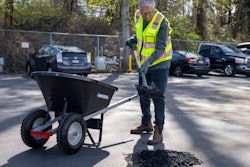
High-performance, proprietary repair materials can be placed in cold, wet conditions and still perform to spec.
Use of such a mix in late winter or early spring would probably be a stop-gap measure until weather improves. In winter, such material congeals and is not easy to work with, while in summer the material is fluid and sticky.
“The second type is cold mix produced according to specifications set by the agency that will use the mix,” FHWA said. “The specifications normally include the acceptable types of aggregate and asphalt, as well as acceptance criteria for the agency to purchase the material. The aggregate and asphalt usually are tested for compatibility before specifying acceptable sources.”
The use of pothole repair spray-injection equipment (see below) by agency forces would fall into this category, as the agency must check the asphalt-aggregate compatibility before placing patches, FHWA said.
“The third type is proprietary cold mix,” FHWA said. “A local asphalt plant generally produces this material using specially formulated binders. These binders are produced by companies that test the local aggregate, design the mixes, and monitor production to ensure the quality of the product. These materials (like other cold mixes) can be produced in bulk and stockpiled, or they can be packaged into buckets or bags to make the material easier to handle in the field.”
Spray-injection patching performed by a contractor would fall into this third category, as the aggregate and binder are supplied by and should be tested by a patching contractor, FHWA said.
MORE FROM Featured Articles
MORE STORIES
POPULAR
COLUMNS
BLOGS
- Obama signs memorandum to expedite infrastructure projects662 Views
- Sydney uses water curtains to alert drivers to stop (VIDEO)391 Views
- Florida’s Red Light Camera Game: G R E E N orange R E D390 Views
- Seattle tests bikes as disaster relief (VIDEO)357 Views
- FHWA deploys bridge-inspecting robots293 Views