

Road Science Tutorial

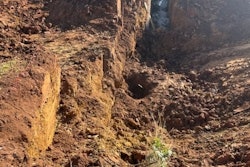
“Daylighted” permeable base – exposed here at the shoulder – is a lower-cost PCC pavement drainable design that doesn’t require separation fabric or drainage systems.
Base and subbase layers that are composed of expansive soils with an abundance of clay must be stabilized, frequently done with cement. This is particularly true of soils in Louisiana, Texas and the American Southwest. Expansion of these base and subbase layers will cause heaving in the pavement, forcing it upward, causing it to fissure and break. The pavement likely will have to be completely reconstructed.
Layers of Pavement Structure
The pavement structure is composed of layers beginning with the subgrade, topped by the subbase, the base course, and lastly one or more surface courses. On roads with lighter traffic loads, the surface course(s) may rest directly on the subbase.
The surface courses can be a single course of PCC, although simultaneous twin lifts of PCC are being studied (see “Research that Can Change the Way We Work,” April 2011, pp. 26-39); or one, two or even three courses of hot-mix asphalt or its warm- and cold-mix permutations. These will rest on base and subbase layers that can be unbound, bound, or stabilized by a variety of methods, including cement- or lime-slurry, dry cement or lime, asphalt emulsion, or foamed asphalt.
The subgrade is the graded, prepared ground beneath the subbase layer. It’s been described as the point at which excavation ceases and construction starts, and supports the entire pavement structure and traffic loads.
In practice, the subbase becomes the main load-bearing layer of the pavement, evenly spreading the traffic loads across the subgrade. The materials used may be soil-aggregates, unbound granular material, or bound granular material.
Soil-aggregate subbases consist of soil from the subgrade, combined with mineral aggregate present on the road surface, with or without additional aggregate. ASTM D1241-07, Standard Specification for Materials for Soil-Aggregate Subbase, Base and Surface Courses describes soil-aggregate as: sand-clay mixtures; gravel; stone or slag screenings; sand; crusher-run coarse aggregate consisting of gravel, crushed stone, or slag combined with soil mortar; or any combination of these materials. These subbase materials are spread, shaped and compacted in accordance with Department of Transportation (DOT) contract documents.
They differ from granular subbases, which are composed of granular material that may be present on the roadbed, plus a specified quantity of virgin aggregates – with or without recycled materials – that meet strength, abrasion and gradation specs. The granular mixture is placed on a subgrade, uniformly moistened, shaped and compacted to spec.
Aggregates used in granular base and subbase applications generally consist of sand and gravel, crushed stone or quarry rock, slag, or other hard, durable material of mineral origin, according to the Federal Highway Administration (FHWA). The gradation requirements vary with type base or subbase.
“Granular base materials typically contain a crushed stone content in excess of 50 percent of the coarse aggregate particles,” according to the FHWA. “Cubical particles are desirable, with a limited amount of flat or thin and elongated particles. The granular base is typically dense-graded, with the amount of fines limited to promote drainage.”
Granular subbase is also dense-graded, but tends to be somewhat coarser than granular base, FHWA says. The requirement for crushed content for granular subbase is not required by many agencies, FHWA says, although provision of 100-percent crushed aggregates for base and subbase use is increasing in premium pavement structures to promote rutting resistance.
“A granular subbase course is that part of the pavement structure constructed to provide a foundation for the base course, to distribute the superimposed loading to the subgrade and to provide drainage beneath the base and surface courses,” states the Wisconsin DOT in its Construction and Materials Manual. “It usually consists of natural sand or a mixture of sand with gravel, excavated and constructed with grading equipment as an item under a grading contract.”
MORE FROM In the Magazine
MORE STORIES
POPULAR
COLUMNS
BLOGS
- MoDOT employs robot to mow roadside grass1528 Views
- I-5 bridge expected to reopen in mid-June990 Views
- CDOT “Slow for the Cone Zone” ads depict kids as construction workers460 Views
- USDOT to release $15.6 million for I-5 bridge435 Views
- 25 percent of U.S. bridges classified as deficient in 2012355 Views