


Road Science
Better Roads Staff
Benefits, FHWA says, include:
* Reduction of on-site construction time;
* Reduction of environmental impacts;
* Improved work zone and worker safety;
* Lowered initial and life-cycle costs; and
* Improved product quality via a better-controlled manufacturing or assembly environment and cure times, and easier access to components in a plant facility.
“Prefabricated bridge elements especially tend to reduce costs where use of sophisticated techniques would be needed for cast-in-place work, such as in long water crossings or higher structures like multi-level interchanges,” FHWA says.
But while precast, post-tensioned concrete I-beams and box girders have been used in repetitive bridge construction for decades — as in lengthy causeways along the Gulf Coast and in Florida, for example — what is new is the near-complete assembly of bridge superstructures from manufactured components on the jobsite but out of the right-of-way.
“The lion’s share of the construction work is done off-site, usually in a nearby staging area, and the new bridge superstructure is lifted or ‘rolled’ into place,” FHWA says. “This method takes advantage of precast elements to minimize the impact of the project on motorists by reducing the time needed for roadway work zones.”
Prefab elements for a superstructure will include: deck panels, both partial and full depth, precast or steel stay-in-place; I-beams with more efficient designs; and composite decks. Substructure prefab elements can include: pier caps, columns and footings; abutment walls, wing walls and footings; and bent caps.
“Increasingly, innovative bridge designers and builders are finding ways to prefabricate entire segments of the superstructure,” FHWA says. “A substructure system may consist of individual piers or prefabricated bent caps supported by prefabricated columns and/or prefabricated abutment elements. Total prefab bridge systems offer maximum advantages for rapid construction and depend on a range of prefabricated bridge elements that are transported to the work site and assembled in a rapid-construction process.”
An Early Adopter
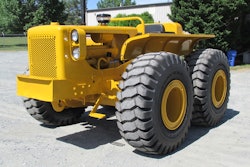
Famously, the Utah DOT was an early adopter of prefabricated superstructure technology. In October, 2009 – as part of its Corridor Expansion (CORE) program – Utah used giant self-propelled modular transporters (SPMTs) to move bridge spans into place at Pioneer Crossing over I-15 at American Fork, south of Salt Lake City.
A south bridge span over I-15’s northbound lanes for a new diverging diamond interchange was moved into place with SPMTs on a Friday night, and a span over the southbound lanes was moved into place just two days later on Sunday night. Then, the existing four-span bridge was dismantled without reducing the Interstate’s three-lane capacity in each direction.
Then, on a weekend in June, 2010, the north bridge for the interchange was moved into place from a staging area in the northwest quadrant outside the interchange southbound ramp, over a quarter-mile from the bridge. The span over the southbound lanes of I-15 was moved into place on a Friday night, and the span over the northbound lanes was moved into place on the following Sunday night. These bridges over I-15 are the largest multi-girder spans moved with SPMTs in the United States.
The two spans of the north bridge had been constructed on temporary support piers in the staging area. Then, the SPMTs were moved under one 186-foot-long span, with nine 96-inch prestressed concrete Washington State bulb tee girders in the cross section. The span had a 45-degree skew and weighed 2,100 tons. Two lines of SPMTs had to be configured to support the massive span at each end.
Special tower stand jacks raised and lowered the span off the temporary supports and onto the new substructure elements, respectively. Chains were also used to help control the distance between the double lines of SPMTs. On the top of the bridge, piano-like wire was placed at the diagonals of the span to measure any span distortion. To avoid overstressing the deck concrete, only inches of distortion was allowed. The span superstructures were placed late Friday evening into early Saturday morning, and late the following Sunday night into early Monday morning, with minimal traffic restrictions and lane closures.
MassDOT: 14 in 10 Weekends
This summer, Massachusetts DOT achieved a remarkable bridge replacement record, with 14 bridges replaced in Medford, Mass. over 10 weekends from June to August with its I-93 “Fast 14” Rapid Bridge Replacement Project.
Because MassDOT used cutting-edge accelerated bridge construction techniques and materials to replace the bridges, all the bridge and associated work was completed over a five-month period.
MORE FROM In the Magazine
MORE STORIES
POPULAR
COLUMNS
BLOGS
- Sydney uses water curtains to alert drivers to stop (VIDEO)662 Views
- Rand Paul introduces bill to fund emergency transportation projects464 Views
- Big four cellphone companies jointly launch anti-texting campaign268 Views
- Acceptance of connected vehicles depends on cost, LaHood says260 Views
- Cities rethink transportation due to drop in young drivers243 Views