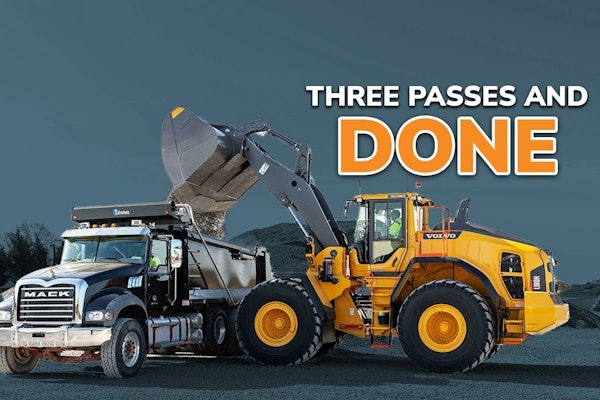


Is it time for a new wheel loader?

Cat’s K series drivetrains have single clutch speed shifting. The machine senses torque going through the drivetrain and will put the machine in the right gear to match demands. “This is a big change from five to seven years ago,” says Gold. “A lot of operators like to manually shift, but auto shift offers a large fuel savings.”


Cabs

LCD monitors, rear-view cameras, and smoother controls top the improvements here. One example is Komatsu’s dash-7 cabs, which have a 7-inch LCD monitor panel with an easy-to- navigate menu system.

In-cab rear cameras are becoming common, assisting operators in seeing over the hood, which in some models became larger to allow room for emission reduction components. Loader controls are now electronic pilot control.

“Electrohydraulic controls have decreased in-cab hydraulic lines and increased cab space,” says Nick Tullo, product marketing specialist, Volvo Construction Equipment. Another benefit: seat-attached control units have replaced control towers. They also allow in-cab adjustments of boom and bucket detents, eliminating the need to manually adjust detents.

Cat’s 966K has low-effort electrohydraulic joystick steering system with a force-feedback feature that automatically increases joystick effort as ground speed increases. “This completely eliminates the need for a steering wheel,” says Gold. “Even though it’s an electrohydraulic system, it feels like it’s mechanically turning the machine left and right. The operator can have full control of the machine without the steering wheel.” Sensors on the lift and tilt functions allow operators to set the attachment position from inside the cab.

Hydraulics

Manufacturers now have on-demand load sensing hydraulics. “We also offer simultaneous lift and tilt, so there’s no priority of lift over tilt, and it allows smoother operation,” Gold says. Cat, for example, gives operators the ability to set the dump height, return to dig and work tool attack angle from inside the cab. “Let’s say you’re dumping to a 5-foot conveyor. This let’s you set the dump height to 7 feet, instead of all the way to 9 feet,” Gold says.

The IntelliDig system on Kawasaki’s new 85Z7 and 95Z7 balances rimpull and hydraulic force, metering out power, as the bucket moves into a pile.


Maintenance/serviceability

Manufacturers have increased cooling capacity, offering wider cooling fin spacing and auto-reversing fans to keep the radiator clean. Service intervals have been extended, says Deere’s Chesterman, compared to machines that debuted in the mid-2000s. Engine oil changes moved from 250 to 500 hours, and in-tank hydraulic fuel tank filtration allows more capacity, moving change intervals up to 4,000 hours.

On it’s K Series loaders, Cat improved on the electric and hydraulic service centers it first featured with its H Series. Grouping these centers allows faster maintenance and repair, Gold says.

Komatsu has added swing-out rear fenders and coolers to improve serviceability access to the engine and cooling components.


Stay tuned

Several new loaders are in the wings:

Deere’s 644K hybrid, introduced at ConExpo in 2011, will debut a production model later this year. The machine will feature an electric drive, with a single motor and generator, that allows the 6.8-liter engine to run at a constant 1,800 rpm engine speed, quickly generating full power. The constant engine speed also allows the hydraulic response to remain steady, instead of varying with engine speed. “This will help newer operators easily gain the crowd force needed to get a full bucket out of the pile,” says Chesterman.

The next machine in Komatsu’s lineup will be the 5- to 6.8- cubic yard WA470-7, which will have the same cab as the WA380-7, and is expected to be out later this year.

The Cat 966K XE, which debuted at Intermat in April, will reach North America by early next year. The XE, which Cat says can deliver up to 25 percent fuel efficiency improvement, uses a hydraulic variator instead of a torque converter for reduced heat generation under severe rimpull load. When under heavy loads, the continuously variable transmission consumes roughly half of the energy compared to a conventional transmission.


In the Interim …

The diesel particulate filter on Tier 4 Interim engines requires a regeneration – which removes soot from the filter. A number of manufacturers have made this a passive function, requiring no operator input. “When you go into auto regen, it pops up on the monitor screen, and then goes into regen automatically as long as you keep operating the machine,” says Deere’s John Chesterman. A complete DPF cleaning will be required around every 4,000 hours.

View Full Article
comments powered by Disqus
advertisement
advertisement
advertisement