

Highway Contractor
Many managers have long relied on “the white board,” he says, “and that’s good – you’ve got visibility to it and it’s easy to use – but it doesn’t tie into anything. Just because you change the assignment on a white board doesn’t mean that’s going to happen. It’s just words written on a white board. We have to actually make sure somebody gets notified.”
Spectrum and other products on the market will not only track the asset or even components of the asset, but “it turns into a real system. It’s not just on the white board in that one room,” says Mathews. “It’s actually available to more than one person in more than one location, but also it does something. It’s actually controlling where the equipment goes,” via such tools as e-mail alerts to operators and service personnel.
“And, of course, we are keeping that scheduling information. We’re not putting it on a white board and erasing it . . . and history’s lost.”
What about right now?
So, big picture, the ability to have detailed history on assets allows agencies and contractors to make informed equipment management decisions.
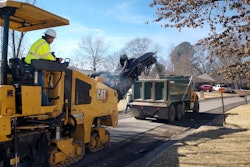
At this moment, though, that’s of little consolation, because the paving train is moving at as slow of a crawl as possible without actually stopping. “Where are those @#&<%! trucks?”
With the current edition of its flagship product, the recently launched Fleet 8, Telogis has incorporated dynamic weather and traffic data, allowing fleet managers to make routing and allocation decisions based on real-time field conditions. “In the event you have to be on multiple sites throughout the day and need to understand how to get there,” says McCormick, “you can visualize traffic and optimize your route based on traffic information. The third-party traffic data set is similar to what you’d see on a Google Map, where you have the red, yellow, green lines to represent different flows of traffic. On top of that, we have also enabled software to find the nearest vehicle or asset based on what the traffic information is stating. So, if there is a construction emergency somewhere and you need to get a truck out there, you can find the nearest based on the traffic information.
“When you have to move assets from one site to another,” McCormick continues, “how do you get them there in the most efficient manner? Being able to take into account real-time traffic information is obviously going to be very important.”
The third-party weather feed provides real-time, radar-generated conditions, including wind data, as well as forecasts of rainfall and pending storms. Other components added with Fleet 8 include an International Fuel Tax Agreement/International Registration Plan data feed, a fuel card reconciliation module, multiple vehicle histories and streetside/bird’s-eye view imaging. The latter, provided by Bing, allows contractors to scope out sites in advance as well as monitor construction activities as they occur, says McCormick.
MORE FROM Highway Contractor
MORE STORIES
POPULAR
COLUMNS
BLOGS
- Rand Paul introduces bill to fund emergency transportation projects475 Views
- Sydney uses water curtains to alert drivers to stop (VIDEO)461 Views
- Tesla Model S earns top ratings from Consumer Reports427 Views
- Big four cellphone companies jointly launch anti-texting campaign260 Views
- Acceptance of connected vehicles depends on cost, LaHood says253 Views