



Highway Contractor
Better Roads Staff
Williams acknowledges what all road departments know: Pavement restoration is expensive and disruptive, and there is a lot of potential savings if the department and the utilities can coordinate to minimize interventions. In Chicago, both the water/sewer department and People’s Gas have accelerated utility replacement programs underway, so the DOT is coordinating closely with them to maximize efficiency in restoration and to improve mapping of utility locations.
Chicago DOT is also experimenting with reverse auctions online for letting contracts. The department’s initial foray into these waters is a series of contracts for median and boulevard landscape and maintenance services this year. Contractors will have an opportunity to bid on the work knowing the amount of the current lowest bid.
“If we can save money with the reverse auctions,” says Williams, “we’ll use them for other kinds of contracts.” Discussions are underway to determine if that format will help attract bids for contracts such as supplying portland cement concrete for the city’s paving crews. She adds that other city departments are using the format, too — to purchase new police cars, for example.
Among local government road departments, Chicago DOT is different in many ways, from its sheer size and the complexity of its mission, to its heavy use of composite pavements and its enthusiastic embrace of high ratios of recycled materials. But the challenges the department faces are the same almost everywhere: Do more with less…and do it better.
Producing a 100-percent Recycled Surface Lift
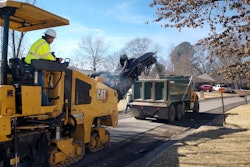
On a chill Chicago morning last November, several dozen people clustered along an ancient residential street to watch a two-machine recycling process convert the road’s pock-marked,
wreck of a surface into a smooth, long-lasting friction course — all in a single pass and without the use of any virgin materials except for the rejuvenator.
Such is the promise of Gallagher Asphalt’s new Re-HEAT in-place asphalt recycling system.
Conventional hot-in-place recycling systems heat the asphalt surface to a workable temperature, then use tines to scarify it to a predetermined depth, mixing in fluids to rejuvenate the old asphalt cement as the HIR train moves along. The hot asphalt is then bladed to a smooth surface and correct grade, and compacted. The recycled pavement is covered with a surface treatment, usually a thin-lift hot or warm asphalt.
Gallagher’s Re-HEAT system employs the same heating technology to slowly heat the pavement to a workable temperature, then, instead of scarifying it, the system uses a moldboard and auger to pick up material at a pre-set depth and move it into a drum where it is mixed thoroughly with a rejuvenating fluid. The rejuvenated mix exits the mixing drum in front of the asphalt screed, then placed and compacted to specifications.
The result, says Gallagher, is a finished pavement that needs no surface treatment, can be opened to traffic in short order, and has a projected service life of a decade or more, assuming the original pavement was adequate for the current and future traffic loads.
Based in south-suburban Chicago, Gallagher Asphalt is one of the largest asphalt producers in Illinois, and one of the leaders in heat scarification HIR, both in its home state and nationally. The Re-HEAT system will add to the diversity of solutions the company offers, says Patrick Faster, national sales director of the company’s hot-in-place recycling operations.
“Compared to a conventional mill and fill, it saves a lot of time and a lot of money. It also costs less than heater-scarification HIR and an overlay,” says Faster.
Dan Gallagher, who owns and operates Gallagher Asphalt with brother Patrick and cousin Charlie, notes that there are applications where heater-scarification HIR is the better fit. “If the existing pavement structure needs to be stronger, the overlay of virgin mix that comes with heater scarification is the better option,” he points out.
Chicago Department of Transportation officials watching the demonstration project were enthusiastic about the concept and interested to see the results. Along with the potential cost savings, Gallagher Asphalt quotes a study that indicates Re-HEAT has a 63-percent smaller carbon footprint than a conventional 2-inch mill-and-fill and fill using 20 percent RAP in the mix — the benefits of eliminating virgin materials and delivery trucks.
As the first outing for Gallagher’s Re-HEAT equipment, the Chicago demonstration project made good on much of the system’s promise while also showing its main challenge. On the impressive side of the ledger, operating in cool weather and on a pavement that may have been older than many of the onlookers, the new recycling train produced smooth, tight asphalt to a depth of 1.5 to 1.75 inches. Densities were reading in the 93- to 94-percent range and the recycled surface was opened to traffic a short time after the HIR train passed.
On the “challenge” side of the ledger, there were several instances when the recycling machinery hit segments of oil-rich road patches and produced thick clouds of smoke and fumes, reminiscent of the early days of HIR applications several decades ago. This is not likely to be a persistent problem with the Re-HEAT system, the Gallaghers say, pointing out that the Re-HEAT heating technology is identical to time-proven heater-scarification equipment. The smoke on this demonstration project resulted from an unusual degree of variation in the surface asphalt content, the cool weather conditions, and a crew just getting familiar with new equipment.
MORE FROM Highway Contractor
MORE STORIES
POPULAR
COLUMNS
BLOGS
- Rand Paul introduces bill to fund emergency transportation projects475 Views
- Sydney uses water curtains to alert drivers to stop (VIDEO)473 Views
- Tesla Model S earns top ratings from Consumer Reports427 Views
- Big four cellphone companies jointly launch anti-texting campaign260 Views
- Acceptance of connected vehicles depends on cost, LaHood says253 Views