


Highway Contractor
Better Roads Staff
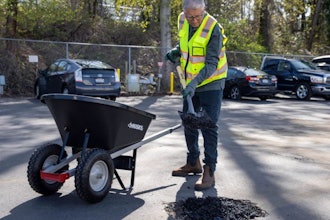
Crack Treatments
As highway agencies have migrated to a prevention-first philosophy of road management, emphasis on crack treatment has grown. The process is inexpensive and has been shown to extend pavement life by two years and often more.
Galehouse considers crack treatment an important tool in the pavement manager’s toolbox.
“There are two approaches,” he says. “Crack sealing is a series of steps that first machines a reservoir in the crack, cleans the reservoir with compressed air, and then fills it with sealant. This approach can be very effective when used on the right pavement at the right time.” Galehouse estimates that crack sealing typically extends pavement life at least two to four years.
Crack filling, a process in which debris is blown out of the crack and the crack is filled with sealant, is used for nonworking cracks and wider cracks. Galehouse says crack filling typically adds about two years to the life of a pavement.
“Both of these processes are pothole preventers,” he says. “And the longer you can prevent potholes, the longer you can avoid more-expensive interventions like milling and overlays.”
Surface Treatments
Chip sealing has evolved as rapidly as any preservation technology over the past decade, says Galehouse, as contractors and suppliers have stepped up the quality of materials and application techniques. “It’s more of a science now,” says Galehouse, “though there are still people who don’t recognize it as such.”
Perhaps the most dramatic leap forward in chip sealing will be offered through the SHRP2 (Strategic Highway Research Project) Project R-26 in which chip seals with carefully selected aggregate and emulsion applied with precise construction technique and finished with a fog seal can be placed on high-volume roads. This will finally demonstrate that chip seals can perform excellently on high-volume roads when care is taken in design and construction, says Galehouse.
“A high-quality chip seal applied to a sound pavement prevents sunlight and water from destroying the pavement,” says Galehouse. “It also adds macro-texture to the road surface to enhance traction, and with a fog seal it provides more visibility to paint markings by improving contrast.”
Other surface treatment interventions include slurry sealing and microsurfacing. Slurry seals are a mixture of fine aggregate, emulsified asphalt, water and additives placed by special machines in a thin coat, one stone thick. The slurry seal fills hairline cracks and delays pavement oxidation, and is appropriate for urban/suburban neighborhood roads in good condition.
Microsurfacing is a slightly thicker intervention than the slurry seal, combining polymer-modified asphalt emulsion, crushed aggregate, water and other additives in a carefully specified mix design, and placed by specialized equipment. “Microsurfacing adds thickness to the pavement structure, so it can correct rutting and minor raveling, and improve friction,” says Galehouse. “It is also designed to stand up to high-traffic volumes and heavy loads.”
Overlays
The next stop on the prevention continuum for asphalt pavements is the ultra-thin overlay — typically, 3/4-inch thick or less. “This is an intervention for a sound pavement,” says Galehouse. “With the advances in mix design and placement practices, it has become a very effective tool. It protects the surface of the original asphalt, fills minor imperfections, and improves ride quality.”
Ultra-thin overlays can also be designed to deliver other benefits. Use of a rubberized asphalt binder, for example, can mitigate traffic noise with great effectiveness. An open-graded friction course design can reduce spray during rain and enhance the quality of runoff water.
Thin overlays — up to 1.5 inches in thickness — cost more, but by virtue of their thickness can smooth out deeper imperfections, and achieve greater smoothness that improves the ride quality of the pavement.
Milling is the tool when the surface pavement has deteriorated beyond the point where lesser interventions can restore its condition. Milling is also employed in metropolitan areas where a simple overlay will not align properly with gutters.
MORE FROM Featured Articles
MORE STORIES
POPULAR
COLUMNS
BLOGS
- Rand Paul introduces bill to fund emergency transportation projects472 Views
- Sydney uses water curtains to alert drivers to stop (VIDEO)466 Views
- Tesla Model S earns top ratings from Consumer Reports435 Views
- Big four cellphone companies jointly launch anti-texting campaign260 Views
- Acceptance of connected vehicles depends on cost, LaHood says252 Views