


Find out who ACPA named as recipients of annual ‘Excellence in Concrete Pavements’ awards

Interstate-664 is a major urban freeway connecting Newport News and Suffolk, Va., by way of the Monitor-Merrimac Memorial Bridge Tunnel. In Newport News, it is a six-lane divided Interstate highway with a median barrier wall. In 2010, the estimated average annual daily traffic was up to 74,000 vehicles with 6 percent trucks.

The CPR project called for 54,000 SY of full-depth concrete patching on continuously reinforced (CRCP) and jointed plain concrete pavement (JCP); grinding about 110,000 SY of CRCP; and removing and replacing approximately 800 lineal ft of misaligned/leaning barrier wall. The project also called for installation of about 21,000 lineal ft of drain; adjusting existing/installing new guardrail; and milling and replacing about 12,000 tons of existing asphalt.

Much of the original concrete pavement was constructed in about 1983 using 8 in.-thick continuously reinforced concrete pavement for the mainline, and 9 in.-thick jointed concrete pavement for the acceleration/ deceleration lanes and ramps. In 2007, after 24 years of service with only minimal maintenance requirements, the concrete pavement was in need of rehabilitation.

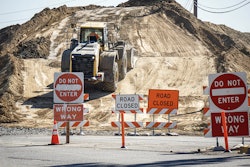
The contractor was required to maintain traffic during the CPR project. Lane closures were only allowed between 7 p.m. and 5 a.m. Completing the project required close coordination between the Denton crews and the concrete plant to ensure the proper amount of concrete was delivered, and that the concrete had sufficient time to cure properly. This was a difficult balance to reach, but was achieved by precisely proportioning concrete delivered to the grade, and by using accelerating admixtures that allowed opening to traffic on patched areas in 4-1/2 to 5-1/2 hours.

Safety was a key consideration, so in addition to workers wearing Class II reflective vests and hard hats, the work zone was delineated from the live traffic utilized reflective plastic drums and traffic cones. Workers were protected by the use of impact attenuators, as well as by a spotter that would sound an alarm to alert workers of possible danger.

One other unique aspect of this project is that the contractor simply submits a mix design for approval at the start of the job, and once the mix design is approved, the contractor is not required to test materials during production and placement, and instead, must provide a one year warranty for any materials and workmanship issues. This stemmed from a joint ACPA/Virginia DOT Task Force initiative to review and rewrite the Concrete Patching Special Provisions, which have been modified slightly since 2002, but remain in effect. After thousands of patches, the warranty replacement rate is below 1 percent.

The Virginia DOT developed and implemented an extensive communications plan to distribute information to the motoring public. The plan included lane closure reports posted on the agency’s website and emailed to local media; listings in the Virginia 511 system; an interactive, voice-activated traffic information system accessible by phone and the Virginia’s 511 website; and announcements on the state’s Highway Advisory Radio.

To alert motorists traveling in this area to the upcoming traffic shifts, advance warning notifications were posted on portable, changeable message signs. Information about the project was also included in the VDOT Dashboard, a web-based performance reporting system with a search feature for information on projects and programs.

View Full Article
comments powered by Disqus
advertisement
advertisement
advertisement