

LaHood announces $1 million in immediate funding for I-5 bridge in Washington
U.S. Transportation Secretary Ray LaHood has announced the immediate availability of $1 million federal emergency funds for Washington State to use toward the repair of the Interstate 5 bridge that collapsed into the Skagit River last night.
“We are doing everything possible to restore mobility as quickly as possible and expedite repairs,” LaHood said.
The funds are intended for the Washington Department of Transportation (WSDOT) to use toward the installation of temporary bridges over the river and permanent repairs to the bridge.
The funding comes from the Federal Highway Administration’s (FHWA) Emergency Relief (ER) program, which offers funding for highways and bridges damaged by natural disasters or catastrophic events.
“We will continue to stand by Washington until all repair efforts are completed and this vital transportation link for international commerce is back up and running again,” FHWA Administrator Victor Mendez stated.
The bridge collapse has caused delays in the Skagit County area south of Burlington, as the bridge carries approximately 71,000 vehicles daily between Washington and Canada. WSDOT announced alternate routes earlier today.
Remember the Alamo Bridge in Washington

(Photo: modified from Cole Wagoner / Twitter)
If a bridge falls in Washington State does anyone in Washington D.C. hear it?
Yes, but for how long will its crash echo in their thoughts? There has been, historically, a relationship between a collapsed bridge span and a collapsed attention span.
When a section of the I-5 bridge over the Skagit River in Mount Vernon, Washington, fell into the water on Thursday, I thought of the aftermath of a previous catastrophic bridge failure.
The I-35W Mississippi River bridge was an eight-lane, steel truss arch bridge that carried Interstate 35W across the Mississippi River in Minneapolis. During the evening rush hour on August 1, 2007, it collapsed. The disaster killed 13 people and injured almost 150. It’s possible the I-5 bridge did not simply collapse but fell after a big rig hit part of the bridge–but an Interstate bridge should be able to withstand such an impact without falling.
My thoughts went back to conversations I’d had with two men in Washington D.C. They might have been The Odd Couple, but actually Jim Oberstar and John Mica were the dynamic duo of the pre-2011 House Transportation and Infrastructure Committee, working well together, Oberstar as Chairman and Mica as Ranking Member. Then of course Oberstar lost his re-election bid and Mica took over as chairman until we moved on to Bill Shuster.
They had similar ideas on a surprising number of transportation infrastructure issues, and one of them both publicly, and privately, was to bemoan the fact that just a month after the I-35W collapse a window that opened when the bridge fell, had closed.
With rescue crews still at work in the Mississippi River there was a widespread sense of urgency in Washington, D.C., a feeling that something must be done to make sure no more bridges fell, that if funding was needed it must be found, that if there were inspection or design or construction problems they had to be addressed as soon as possible. Action was needed; something rotten in the state of our bridge infrastructure had been revealed to us via a tragedy and it had to be fixed.
The public had an equal fervor for safe bridges for this one month too. The collapse shook people all over the country. But this is an age of buckets full of worry and many of them reclaimed their place in the public mind. Assurances had come from Washington that what had to be done was being done–and indeed it was.
As Oberstar and Mica both noted sadly, a month later the rhetoric could still be heard but the hottest part of the fire had died. When the urgency left the building, the “fix the bridges” campaign fell back to become the work of committees and task forces and hearings, all certainly essential parts of the machinery we need to fix our transportation infrastructure. The opportunity to for a grand project had slipped through our fingers and business as usual had returned.
On a positive note, Oberstar and Mica also agreed that the fallen bridge’s replacement was a classic example of what could have happened if the fire had kept blazing. The multiple award-winning I-35W Saint Anthony Falls Bridge shows that great bridge work can be done in far less time that we have come to expect for major transportation infrastructure projects, and it can be done through the cooperation of all of the stakeholders and with a goal-oriented mindset that’s so wonderfully old fashioned it could remind you of the way our first interstate builders took to their work back in the 1950s.
Informal reauthorization discussions are underway in D.C. It would be a very effective move to make sure the people that represent you and your family continue to remember the Washington and Minnesota bridge failures and realize the public wants safe transportation infrastructure and would pay for it if their legislation could help ensure it.
If they can remember the Alamo they can remember this bridge collapse and keep it fresh in their minds as they work on the next bill.
And check this out: Better Roads’ annual Bridge Inventory looks at the rate of functionally obsolete and structurally deficient bridges in America and the numbers are startling.
Contributed Story: Holland Surveyors founder launches road slope measurement tool with Fowler Wyler Inclinometer
Fowler Wyler Clinotronic Plus enables land survey company’s Accu-Slope product to improve measurement accuracy and speed
The Challenge
About eight years ago, Holland Surveyors served as a road survey subcontractor to paving companies with the South Carolina State Department of Transportation’s (DOT) interstate rehabilitation projects.
For these projects, Holland Surveyors measured the inclination of a road surface called cross-slope, i.e. the downward slope of the road on each side to minimize water accumulation on the road. Measuring cross-slope must be done continuously during road construction to ensure the inclination is within certain specifications.
The South Carolina DOT has tight cross-slope specifications that paving contractors must meet, according to Holland Surveyors President and Operations Manager Al Holland. The cross-slope specification provides tolerance guidelines or cross slope ranges for the contractors to stay within. The Level One tolerance equates to no more than a 1/4-inch of slope across a 12-foot-wide travel lane.
Typically, travel lane cross slopes had been measured and checked using traditional surveying methods. These methods required using two or three man survey crews with auto levels or total stations to collect rod readings on the travel lane. Additional time was then needed to perform calculations to determine the cross slope based on the observed readings.
The traditional methods were prone to errors that frequently degraded accuracy to a level that made them ineffective for checking the narrow tolerances required.
Al Holland said, “These challenges are what drove me to look for a better way.”
The Solution
Developing his own approach to cross-slope measurement, Al Holland began looking for a digital inclinometer to integrate into his product design.
“I heavily researched the measurement component of my product and looked at many products to find a truly precise inclinometer,” said Holland. “The Fowler Wyler Clinotronic Plus best fit my needs, and after integrating it into my frame and testing it, I realized it did a surprisingly good job and never considered trying other products.”
The inclinometer had to be able to withstand the high temperatures associated with paving activities, be simple to operate, be power efficient and provide the precision required for the cross slope measurements. The Fowler Wyler Clinotronic Plus met all of those conditions.
The Fowler Wyler Clinotronic Plus is a versatile electronic inclinometer. It is economically priced and uses a specially-designed microprocessor and the Wyler inclination sensor. Its features include:
• Range of ±45 degrees, capacity of zero to 360 degrees
• Resolution of 0.01 degrees (selectable)
• Adjustable base length
• Display: use any units common to inclination measurements
• Desired units to be selected by push button
• Automatic setting of zero by push button command
• Absolute or relative measuring mode selectable by push button
• Built-in calibration program
• Uses standard 1.5-volt AA batteries
• Seal-tec technology for excellent performance even in difficult environmental conditions
• Interface connection RS-232 is integrated; special purpose cables available
• Low battery indication
• No loss of calibration data by power failure
• Includes fitted case
The Results
Al Holland developed his new Accu-Slope product with the integrated Fowler Wyler Clinotronic Plus on the job and found it immediately eliminated many of the problems associated with conventional road slope measurement.
“With Accu-Slope, I was able to provide dynamic, real time measurement reports to contractors as they were placing the asphalt,” said Holland. “The Accu-Slope can be assembled and used by one person and yields a real-time cross-slope value much faster and nearly three times as precise as conventional methods. And not only did I increase productivity, but also saved money on labor costs as I turned my 2-3 man crew into a one-person operation.”
“And Accu-Slope, paired with the Fowler Wyler Clinotronic Plus, gave me an advantage in the competitive bid process to secure contracts with the South Carolina DOT,” continued Holland. “Because I was able to reduce the amount of labor I needed, I could reduce my proposal fees.”
Accu-Slope with the Fowler Wyler Clinotronic Plus is now a patented product, and Al Holland has launched it into the marketplace working with International Cybernetics Corporation. He continues to receive positive feedback from contractors in the field that work with Holland Surveyors.
“Road construction companies like Accu-Slope because state inspectors will make them remove and replace asphalt sections that do not meet the cross-slope specifications. Our use of Accu-Slope prevents this from happening,” said Holland.
Accu-Slope has gained its share of customers, with many road construction companies in South Carolina using this system and other states’ departments of transportation interested in its use. In addition, Holland Surveyors’ own use of Accu-Slope has inspired construction companies they work with to adopt use of the Fowler Wyler Clinotronic Plus and Accu-Slope. One of those organizations is Sloan Construction Company out of Duncan, South Carolina.
“When you are working with state inspectors you need to achieve what they are asking for,” said Danny Doetch, Training Specialist at Sloan Construction Company. “In working with Holland Surveyors we found we didn’t have to correct as many road tolerances that were out of slope. We didn’t want to guess on the specification numbers, and purchased our own Fowler Wyler Clinotronic Plus to prevent having to tear out paving jobs and do them twice. With the Fowler Wyler Clinotronic Plus we are producing a better quality product.”
Holland Surveyors, founded in 1983, is a land survey firm based in Lugoff, South Carolina, providing pre-construction, environmental and control surveys, as well as laser scanning and cross slope verification services within North and South Carolina.
WSDOT announces I-5 detours
The Washington State Department of Transportation (WSDOT) has announced that Interstate 5 has been closed in both directions in Skagit County south of Burlington.
The agency said via Twitter that drivers should avoid the area or expect delays.
WSDOT suggested the following alternate routes:
-
Southbound traffic: Take eastbound State Route (SR) 20, then south on South Burlington Boulevard and west on East College Way (SR 538) to southbound I-5
-
Northbound traffic: Take eastbound East College Way to northbound Riverside Drive-South Burlington Boulevard, then west on George Hopper Road to I-5.
-
SR 9 to bypass Mount Vernon: Take Exit 221 at SR 534 east to northbound SR 9 to SR 20 westbound to I-5.
The map to the right shows the alternate routes. The map is also available at wsdot.wa.gov.
Authorities have not announced any specific replacement plans for the I-5 bridge over Skagit River.
Moore officials open additional roads, police remove check-in points
Moore officials stated on Twitter that several roads have been opened in addition to those that were opened on Wednesday.
The city announced yesterday that Interstate 35 and Interstate 44 are “open but highly congested.” Moore street also opened yesterday, but officials requested no one use that road.
Last night, the city also announced Broadway Avenue between 4th Street and 19th Street had been opened.
Additionally, officials stated on Twitter that Moore Police would be removing check-in points into affected areas within Moore city limits at 7 a.m. today.
For more updates on road closures and openings, visit moore.recovers.org. Updates are also available via Twitter from @CityofMoore.
I-5 bridge collapses, causes no fatalities

Bystanders look at the collapsed I-5 bridge north of Seattle. (Photo: Cole Wagoner / Twitter)
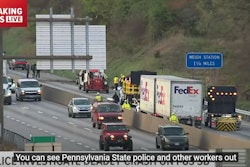
An oversize truck last night struck a portion of an Interstate 5 bridge over the Skagit River between Seattle and Canada, sending the portion of the bridge and its occupants into the river below.
No fatalities resulted from the collapse, CBS News reported. As of 1:14 a.m. Eastern Time, authorities were still searching the river for any additional people, though Marcus Deyerin, a spokesman for the Northwest Washington Incident Management Team, said the team thinks there is no one else in the water.
The three known occupants suffered minor injuries, the Associated Press reported.
According to the AP report, investigators were initially unsure whether the bridge collapsed on its own. But Washington State Patrol Chief John Batiste said at a news conference last night that the collapse occurred when a tractor-trailer carrying a tall load hit an upper section of the bridge.
The truck driver made it off the bridge and stayed at the scene, cooperating with authorities. Two cars fell into the water, taking their three total occupants with them. All three were rescued and were recovering as of Friday morning.
The video below shows rescue workers searching the water for anyone who may have fallen in.
Washington’s Transportation Secretary Lynn Peterson told the AP that the bridge had been inspected and repaired last year, noting that it is “an older bridge that needs a lot of work.”
The Federal Highway Administration’s (FHWA) National Bridge Inventory (NBI) listed the bridge, which was built in 1955, as being “functionally obsolete.” FHWA’s NBI gave the bridge a sufficiency rating of 47 out of 100 in November 2012; an AP analysis revealed the state average as 80.

A man stands outside his truck in the Skagit River after the I-5 bridge collapse. (Photo: KING 5 News / Twitter)
Our 2012 Bridge Inventory, also published in November 2012, reported that 970, or 30 percent, of Washington state’s 3,260 Interstate and state bridges were either structurally deficient or functionally obsolete.
Additionally, the American Society of Civil Engineers gave Washington state a C on its 2013 infrastructure report card and a C- when it came to the state’s 7,840 bridges. ASCE considers about a quarter of those bridges to be structurally deficient or functionally obsolete.
The I-5 bridge was a truss bridge that measured 1,112 feet long and 180 feet wide. It had two lanes in each direction and four spans over the water supported by piers.
There is no word yet on how the city will replace the bridge, but transportation officials are working on either a temporary or permanent plan.
The National Transportation Safety Board has sent a team to investigate the bridge.
The Internet, the public and project input
What is–or, better yet, what could be–happening to the solicitation of public input into transportation infrastructure projects?
“The advent of the internet is making it easier than ever to solicit public input.”
It’s a simple statement from an online resource for sustainable transport news, research and best practice solutions from around the world. But it’s also a true statement.
If Paul Simon could write, years ago, “there must be fifty ways to leave your lover,” we can now say there must be fifty ways to ask for and receive public input into transportation projects.
And there must be almost as many ways to have an interactive relationship with the public with ideas and concerns going both ways and officials basically holding conversations and dialogues with the public from the earliest stages of planning to completion.
There will be those who fear too much of a good thing. Fair enough; you only have to look at comments below major news stories to see that not all discussion is worth the space. But on the positive side the digital revolution means a far more complete public engagement with your work.
Bottom line: social media, tablets and whatever other technology comes up will be conduits for public input into project planning. Evidence from this digital era suggests that those who first embrace the idea will get the best of it. Already a number of agencies in the United States have found online ways to engage their public and their experiences seem to be very positive.
The process is in its advanced infancy, and recent history says it would be unwise to guess which way it will develop.
But we know from organizations that were reluctant to use websites, slow to wire for Wi-Fi and behind the cloud computing curve that it’s probably a good idea to begin looking right now (if you haven’t already) at online ways to reach your public to tell them what is in the works and ask them what they think about it.
ARTBA Foundation awards 2013 Lanford Family Highway Worker Memorial Scholarships
The American Road & Transportation Builders Association Transportation Development Foundation (ARTBA-TDF) has named the 2013 recipients of its “Lanford Family Highway Worker Memorial Scholarship,”
The scholarship, established in 1999, is awarded annually to provide financial assistance for the higher education of children of highway workers killed or permanently disabled on the job.
The following students earned the 2013 scholarship:
-
Vybav Hiraesave (Dover, Delaware), sophomore majoring in chemical engineering at the University of Delaware: Hiraesave’s father, Vasuki Hiraesave, died in an accident while working as an employee of the Delaware Department of Transportation in March 2006.
-
Lyndsay Morgan (Daytona Beach, Florida), up-and-coming freshman to major in athletic training at Florida Gulf Coast University: Morgan’s father, Steven Morgan, died in a November 2011 accident while working on Interstate 75 in Florida.
-
Haley Ward (Tell City, Indiana), up-and-coming freshman to major in biology at the University of Southern Indiana: Ward’s father, Ronald Ward, died on the job in 2005 while working maintenance for the Indiana Department of Transportation.
-
Dallas Jones (Bluffton, Indiana), computer science major at the Indiana Institute of Technology: Jones’ father, Dale Jones, died in a December 2009 accident while working as an employee of the Indiana Department of Transportation.
-
Grant Horn (Whitesburg, Kentucky), up-and-coming freshman to major in automotive diesel technology at the Lincoln College of Technology: Horn’s father, Greg Horn, died in 1997 during a drilling accident while working on a state highway construction project.
-
Alexis Keefe (Wyalusing, Pennsylvania), up-and-coming freshman to major in business at Bentley University: Keefe’s father, Bret Keefe, died in a car accident in 2001 while working for the Pennsylvania Department of Transportation.
Oklahoma DOT helps tornado recovery efforts
Oklahoma Department of Transportation (ODOT) crews have traveled from all over the state to help with recovery efforts in Moore.
ODOT has posted several updates, including photos, to Twitter over the past couple of days about the agency’s crews and equipment cleaning debris in the town.
Check out the Storify link below for a list of cleanup updates from @OKDOT.
[View the story "Oklahoma DOT helps tornado recovery efforts" on Storify]
Foxx confirmation hearing concludes smoothly
Yesterday’s confirmation hearing for President Obama’s nominee for Secretary of Transportation, Charlotte Mayor Anthony Foxx, concluded smoothly, with Foxx making few promises to the Senate Commerce, Science and Transportation Committee and with no hostile questions raised, the New York Times reported.
Though the committee asked Foxx a number of questions, the nominee made a point of keeping his number of promises low. The Charlotte mayor limited his promises his three intended focuses, which include keeping safety as a top priority, improving the efficiency and performance of the nation’s existing transportation system and working to build a transportation system to meet future needs.
Foxx has made transportation a priority in Charlotte. During his term as mayor, the city has expanded the LYNX light rail system and the Charlotte-Douglas International Airport, began work on the Charlotte Regional Intermodal Facility and the Charlotte Streetcar Project, completed the I- 485 beltway and repaired the Yadkin Bridge.
However, Foxx has little experience with national transportation issues. If confirmed, he will face a number of difficult funding issues for roads, air traffic control and the freight rail system.
There has been no word yet on an expected date for the committee’s decision.
The archived webcast of the hearing is available at the Senate Commerce, Science and Transportation Committee’s website. A transcript of Senator John D. Rockefeller IV’s opening statement is available here. To read the transcript of Foxx testimony, click here.
MORE STORIES
POPULAR
COLUMNS
BLOGS
- Obama signs memorandum to expedite infrastructure projects669 Views
- Sydney uses water curtains to alert drivers to stop (VIDEO)394 Views
- Florida’s Red Light Camera Game: G R E E N orange R E D392 Views
- Seattle tests bikes as disaster relief (VIDEO)380 Views
- FHWA deploys bridge-inspecting robots296 Views