
Better Bridges
Better Roads Staff
With the CM/GC approach, all cost negotiations are done on an open book basis. “That means once we start negotiations or are working through estimates, we show material quotes, subcontractor quotes, our production rates, etcetera,” Parrish continues. “Normally, an agency never sees this. It just sees the bid price, which has costs, markups, contingencies, etcetera. Agencies are seeing an incredible amount of details. If they haven’t worked as a contract, they don’t know how estimates are put together.”
Parrish advises that agencies considering the CM/GC approach be very clear with what they want to see and how projects are broken down. “There are general conditions components — onsite trailers, risks, etcetera,” Parrish says.
He adds that the real message that should go out is that it’s important for agencies to understand components of a contractor’s price – i.e. what goes into an estimate. “These components are cost of work, labor, material and equipment costs, general conditions cost, risk cost, and profile or overhead for the contractor,” Parrish points out. “The contractor’s profits are what pay the taxes to support the agency. The CM/GC is where our profit is to reside.” v
Oil Change
Kevin Parrish, project manager with Hamilton Construction, the construction manager/general contractor on the Interstate 5
Willamette River bridge project, explains that all of the company’s ‘diesel’ pile hammers run on biodegradeable oils instead of diesel, not just the WRB hammers. “The best vegetable oil we have found is soybean oil, second best is peanut oil, with canola oil the third best choice,” Parrish explains. “Soybean oil is low in trans fats, which prevents the pile hammer arteries from clogging, just like your heart. The other vegetable oils can start to solidify in the fuel tank if the tank is not drained after each use. The little solid particles can then clog the injectors, which prevents the hammer from firing.”
Fast Facts:
The Willamette River Bridge Replacement Project
The new northbound Interstate 5 Willamette River Bridge in Eugene will measure approximately 1,985 feet.
The demolition containment structure is approximately 127,500 square feet.
For every tree that is cleared because of construction, the Oregon Department of Transportation will replace it with at least two native trees at the completion of the project in 2013. The native species that will be planted include Western red cedars, Oregon ashes, Brayshaw black cottonwoods, Oregon white oaks, big leaf maples and red alders.
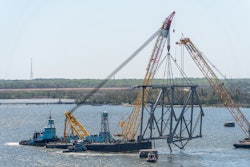
At Better Roads press time, Hamilton Construction had used approximately 14 million pounds of steel beams and piling in the work bridge and demo containment structures, along with nearly 2 million board feet of timber decking.
The Oregon Department of Transportation (ODOT) anticipates that 400,000 hours of construction trade work will be required to replace the I-5 Willamette River Bridge.
The construction team plans to recycle 50,000 tons of concrete.
On the Social Side
Willamette River Bridge blog (ODOT’s first blog in agency history):
http://willametteriverbridge.blogspot.com/
Willamette River Bridge construction update:
http://www.youtube.com/user/OregonDOT#p/u/O/388KpCzlex4
Willamette River Bridge PSA:
MORE FROM Better Bridges
MORE STORIES
POPULAR
COLUMNS
BLOGS
- MoDOT employs robot to mow roadside grass1544 Views
- CDOT “Slow for the Cone Zone” ads depict kids as construction workers451 Views
- USDOT to release $15.6 million for I-5 bridge436 Views
- 25 percent of U.S. bridges classified as deficient in 2012395 Views
- Private money: A funding wildcard in 2014285 Views