

Better Bridges
Better Roads Staff
All Together Now
By Tina Grady Barbaccia
A bridge project that started out under intense scrutiny in an environmentally- sensitive area is now being cheered and even has the locals putting their own touch on the bridge.
The Oregon Department of Transportation (ODOT) credits this to using the construction manager/general contractor (CM/GC) approach — where the contractor works with an agency from the beginning of the project instead of after a design has already been developed.

Looking north at I-5, pictured (from left to right) are the work bridge, the decommissioned bridge and the new, temporary detour structure. The decommissioned structure in the photo has since been demolished.
The Interstate 5 deck arch type bridge over the Willamette River is a $201-million replacement project located at milepost 192.7, where it crosses the river between the cities of Eugene and Springfield. It was funded by the 2003 Oregon Transportation Investment Act and the federal Safe, Accountable, Flexible, Efficient Transportation Equity Act: A Legacy for Users (SAFETEA-LU) program.
“The biggest advantage [to using a CM/GC approach] is the flexibility to balance the public’s expectations while maintaining the level of public participation the owner wants to provide,” explains Kevin Parrish, project manager with Springfield, Ore.,-based Hamilton Construction, which is the construction manager/general contractor on the bridge project.
Traditionally, an agency would determine a project’s scope, the project design, and the schedule. Then, the amount of money to be spent on a project was determined. “A designer would work up the project, put it out to bid, and the contractor with the lowest price would get the project,” Parrish explains. “Then the public would see it.” With the CM/GC approach, the contractor is involved in the entire process. This approach isn’t new. It’s common in the private sector, but for DOTs, it’s considered to be an innovative approach.

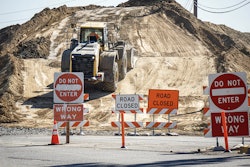
A steel rebar reinforcement cage for bent 6 will be placed into the bent to support and reinforce the structure. The orange signs visible on the bridge in the background are part of the project’s “gawker screen,” a barrier used to prevent drivers from staring at the construction site and keep focused on the road.
“We hire the contractor at the start of the design,” explains Dick Upton, major projects unit manager for ODOT and project manager for the I-5 bridge project. “As construction manager, he [the contractor] and his team work with us through design, fundamentally giving constructability reviews and more or less guiding our construction approach to the way he would prefer to approach the job.”
This is a pilot program for ODOT, and one of the first times this approach has ever been used on horizontal construction. “Before we launched down this path, we did a scan of agencies doing it,” he says. Only Arizona and Utah were currently using the CM/GC approach. “Now Nevada is calling and asking questions [about our approach] too,” Upton says.
Vocal locals
Involving the public from the start was a must.
“In Eugene, members of the community take a high interest in publicly-funded projects,” Parrish says. “The locals are very vocal.”
ODOT is using the high level of interest in the project to help shape the design of the bridge and the surrounding natural area. “There have been some projects that haven’t gone over as well, and ODOT has learned from that,” Parrish says. “ODOT wants to serve the public good. A project that could have generated a lot of negative publicity is now providing eagerly anticipated improvements and enhancements to the surrounding area.”
The bridge project crosses directly over the Whilamut Natural Area, which includes two well-used and very popular bike systems that lead up to the bridge but were not connected. Replacement of the bridge affects usage of the trails.
The CM/GC approach enabled the public to be part of the entire replacement process, and to be sensitive to the needs of the community with how the bridge replacement would affect the bike trail usage. It has helped to make a delicate situation quite manageable, by further keeping the community closely involved in the bridge replacement project. Bridge designers were brought in and the two paths will now be connected, a much-anticipated improvement for the area’s large cycling community. For the community, these improvements have become as important to the locals as the bridge project itself — almost as if it were a bike trail project with a minor bridge component.
MORE FROM Better Bridges
MORE STORIES
POPULAR
COLUMNS
BLOGS
- Rand Paul introduces bill to fund emergency transportation projects475 Views
- Sydney uses water curtains to alert drivers to stop (VIDEO)461 Views
- Tesla Model S earns top ratings from Consumer Reports428 Views
- Big four cellphone companies jointly launch anti-texting campaign261 Views
- Acceptance of connected vehicles depends on cost, LaHood says254 Views