

Better Bridges: Arch artistry
Arch artistry
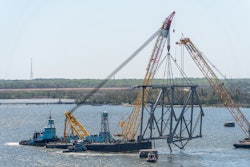
The Route 219 deck arch bridge over Cattaraugus Creek in New York used a complex tie system, a massive crane and a creative erection process.
By Tina Grady Barbaccia

The arch erection process for this bridge used a complex tie system that used adjustability as its key. Three ties were used: An anchorage tie, which connects the top of the permanent concrete pier bent to the anchorage, and two other ties.
For the construction sequence of a deck arch bridge in New York, these were also the keys to the erection of two 460-foot-long twin arches — part of a 750-foot-long bridge over the Cattaraugus Creek. The twin arches are part of a larger $100 million, 4.2-mile highway expansion and improvement project of new construction on Route 219 south of Buffalo, N.Y. The entire Route 219 was designed in 12 sections, four of which are complete, from West Seneca to Springville. The current section under construction begins at Route 39 in Springville and extends to Peters Road in Ashford.
The overall project is intended to address safety and operational deficiencies and the increased truck traffic along the corridor and to enhance regional and statewide economicdevelopment. The roadway consisted of two lanes in each direction and 11 bridges, including the one over the Cattaraugus Creek.
Using a unique approach to arch bridge construction, engineers designed an erection sequence where permanent bridge columns on each side of the Cattaraugus Creek supported the arches during erection. The arches were held in place by ties attached at two points on each arch. The key to the success of this erection process was the adjustability of the ties.
“No doubt, the adjustability was key,” notes Stephen J. Percassi, P.E., project engineer for Erdman Anthony, the company who assisted Woodbury, N.J.-based general contractor Cornell & Company’s in-house engineer with the unique bridge erection process. “Without it, this procedure wouldn’t be possible. We had to have enough adjustability to effectively transfer all the weight from tie No. 2 to the arches so they could act like arches. Three ties were used: An anchorage tie, which connects the top of the permanent concrete pier bent to the anchorage, and two other ties.
“The other two ties — tie No. 1 and tie No. 2 — bear all of the weight,” Percassi says. “We essentially hang all the weight of the arch on them.” The arch was broken into five pieces per half. Each piece was added sequentially, which in turn pulled on tie No. 1 and No. 2, which then pulled on the concrete anchorage/reaction block. “We designed this system so it only needs one arch tie at any given time,” Percassi explains. “It never uses both simultaneously. We designed it this way for adjustability.”
Tie No. 1 was fixed in length and had a hinge at about the one-third point in its length. Tie No. 2 was “the workhorse of the whole system,” Percassi says. Tie No. 2 was designed to have 12 inches of adjustment. When the erector — the Erdman Anthony/Cornell & Company team — installed it, everything was hooked on the tie, he says. “The adjustability of tie No. 2 allowed us to purposely shorten it, erect the arch higher and lower it later,” Percassi says.
This is extremely significant, Percassi points out, because when tie No. 2 was intentionally shortened, it rotated the arch backward. This was possible because tie No. 1 had a hinge on it.
“Tie No. 1 can’t take the compression because it has a hinge on it,” Percassi says. “The hinge in tie No. 1 allows 100 percent of the force to be transferred to tie No. 2.” At this point, tie No. 1 is not doing anything. After the installation of tie No. 2, tie No. 1 isn’t needed anymore.”
After all of five segments that the arch was broken into have been installed, the largest load has been produced. “Once the fifth piece was added, it produced the largest load — 515,000 pounds — on tie No. 2.”
Not according to the ‘original’ plan
This unique process wasn’t part of the original plan. The New York State Department of Transportation (NYSDOT), owner of the bridge and engineer of for its design, initially recommended that a temporary tower be erected to support the arches during construction. The contractor, Akron, N.Y.-based Cold Spring Construction, subcontracted with Cornell & Company to erect the twin 750-foot arch structures. Cornell then hired Erdman Anthony to act as the erection engineer and to assist with putting together the erection procedures and help secure approval from NYSDOT.
“As part of the design process, we suggested an erection procedure,” says Art Yannotti, director of the Structures Design Bureau for NYSDOT. “For the most part, we don’t usually put together a construction sequence on the design plans. It’s up to the contractor to decide how to erect it and submit to the department [NYSDOT] for approval.”
However, because of the complexity of the bridge construction, Yannotti says, NYSDOT put together a possible construction sequence. The contractor submitted its plan and then hired Erdman Anthony. “The contractor had found a better way of doing it,” Yannotti says. With the help of Erdman Anthony, an alternative design was used to save both time and money.
MORE FROM Better Bridges
MORE STORIES
POPULAR
COLUMNS
BLOGS
- Sydney uses water curtains to alert drivers to stop (VIDEO)535 Views
- Rand Paul introduces bill to fund emergency transportation projects464 Views
- Big four cellphone companies jointly launch anti-texting campaign268 Views
- Acceptance of connected vehicles depends on cost, LaHood says259 Views
- Cities rethink transportation due to drop in young drivers237 Views