

Better Bridges
Better Roads Staff
For public assistance projects that are eventually approved: Federal Emergency Management Agency (FEMA) will pay 75 percent of the cost. The remaining 25 percent is split between the state and local government. These projects may include such things as debris removal, emergency services related to the severe storms and flooding, and repairing or replacing damaged public facilities.
“Working in the public sector, we have a fiduciary responsibility to try to use the tools available to us and the best solution at the lowest price,” Degges says. “I’m a structures guy. When you get a fill taller than 35 feet, it starts getting cost-effective to put in a bridge [instead of repairing the roadway].”
Restoring Access to a Community
Degges is quick to point out: “I don’t want to portray it as rocket science; it just made the most sense to build a bridge instead of repairing the road.” When the roadway collapsed, it cut off access to an entire community. “The scope of our department is to keep traffic flowing, so we needed to get the road open in a hurry.”
The detour was via an old state highway without any shoulders, making time of the essence, Degges says. “We needed the road open quickly while being fiduciary with the taxpayer dollars.” When the decision was made that it was most economical to build a bridge, then the question arose, “Could we design a bridge, get it under contract, and meet our time objective of getting it open [quickly]?”
TDOT’s goal was to have the bridge open before the year ended. That left one construction season to build the bridge, including time to do some major geotechnical work. “We really wanted to make the project open to traffic before the end of 2011.”
The project was put on an accelerated schedule, a move assisted by the fact that the road was closed.
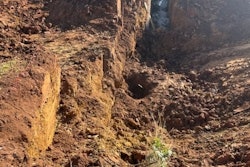
However, in addition to building the bridge and stabilizing the soil around the roadway, TDOT also had to deal with some slope failures. “There was some additional earthmoving that had to be completed adjacent to the project,” Degges explains.
To work with some of the slope failures, Degges says TDOT installed some longitudinal drains, sometimes referred to as slope drains, to assist with the water. “We worked it so [the water] drained, and then we came in and put in the longitudinal drain to drain water out from beneath the slope,” he says. “This helped to stabilize the material there. Water causes stuff to move. It lubricates things and makes stuff slide. We were trying to make sure we got as much water out of the slope as possible. When you have a failure like this, we have to know how deep down it was moving. It was a technically challenging project.”
Carolyn’s Silver Lining
From out of the May 2010 devastation around the town of Santa Fe came a little piece of uplifting news.
While the section of State Road 7 was closed, traffic was detoured onto Old State Route 7 though Santa Fe, and ended up being a blessing to Carolyn Oakley, owner of a local diner, according to a local television report.
Without the road collapse there never would have been a detour, and that may have been the end to the diner, struggling to keep its owner afloat financially and itself hard hit by floodwaters.
But the detour was routed straight past the front of that diner.
According to WKRN TV-Nashville, the diner flooded with 20 inches of water and owner Oakley had to rip out everything and start all over. Although Oakley thought it was a nightmare at the time, she later considered the flood to be a blessing in disguise. “It’s doubled my business,” Oakley told News 2. “Thank gosh, because at first I was going paycheck to paycheck to survive, but now it’s taken a lot of load off me because business is so good.”
The Maury County State Route 7 Bridge Project at a Glance
Project: Maury County State Route 7 bridge construction. State Route 7 is a south-north route in Maury County from the Alabama state line in Giles County, Tenn., to SR-100 in Hickman County
Contractor: Hills Brothers Construction
Sub-contractor (played a large part in drilled shafts for the bridge): Long Foundation Drilling
Road and drainage excavation: 338,580 cubic yards
Contract dates: Effective Dec. 27, 2010; completed Nov. 30, 2011
Bridge dimensions: 684.5-foot-long, 62-foot-wide, three-lane, five-span
Concrete used: 2,257 cubic yards consisting of Class A, D and S concrete
Steel reinforcement: 547,592 pounds used
Go to our digital issue at www.betterroads.com for a picture gallery of the landslide and the replacement bridge.
MORE FROM Better Bridges
MORE STORIES
POPULAR
COLUMNS
BLOGS
- Rand Paul introduces bill to fund emergency transportation projects475 Views
- Sydney uses water curtains to alert drivers to stop (VIDEO)461 Views
- Tesla Model S earns top ratings from Consumer Reports427 Views
- Big four cellphone companies jointly launch anti-texting campaign260 Views
- Acceptance of connected vehicles depends on cost, LaHood says253 Views