
Asphalt Recycling Section
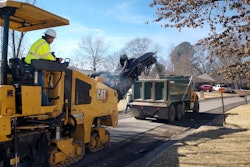
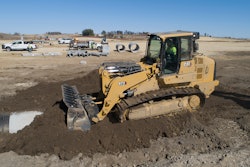
Next, Blount ran two large CMI-made reclaimer-stabilizers in echelon down the roadway. (CMI has since been absorbed by Terex Corp.) The two reclaimers, an RS-800 and an RS-650, first worked a total of one 11-foot lane and stabilized the old asphalt to a depth of 8 inches, Faust said. The reclaimers accomplished a thorough mixing of the cement into the existing asphalt and base. A motor grader shaped the reclaimed material. Next, three rollers – a Hamm 3412 padfoot and two 25-ton rubber-tired rollers, one a Hamm and the other an Ingersoll Rand-handled the compaction chores.
Faust said the two reclaimers worked from the outside edge to the centerline to cover one lane, then reversed their paths and reclaimed the second lane in the same way. “We could cover a little over a half-mile per day, working the full width of the road,” said Faust. “We were spreading 10 tankers per day of cement.”
The 2-inch hot mix overlay followed, as placed by The Scruggs Co., Valdosta, Ga.
“Over the years, we have done some large volumes of FDR work for various counties in Georgia,” says Faust. “I would estimate we have done FDR work in 20 to 30 counties, either working directly for the county or for a general contractor.”
Moye says the FDR process has several benefits:
It can be done under traffic and requires no road closures;
It uses existing materials, which saves trucking and the cost of virgin materials;
It features a quick turnaround. “We started this job the last week in March, and finished the week of April 21.”
“We had a good road base to start with; we just needed to get the base materials up and rejuvenate them,” Moye adds. “Then The Scruggs Co. paved it in one pass.”
Renewing the Road to the Caverns
New Mexico success with its first FDR/asphalt emulsion project.
Full-depth reclamation (FDR) with emulsion resulted in savings of more than $1 million per lane mile, compared to a removal-and-replacement on New Mexico State Highway 7 near Carlsbad.

Full-depth reclamation (FDR) with emulsion eases the cast of fixing a key New Mexico tourist highway.
In this case, the FDR process reclaimed the existing 4 inches of asphalt pavement, mixed it with 4 inches of caliche base and incorporated the emulsion. The 6.5-mile project marked one of the first times that FDR with asphalt emulsion has been used in the state.
“Our total project cost was $3.5 million, or about $269,000 per lane mile,” says Shane McDade, president of Texas Road Recyclers, Fort Worth Texas. The firm provided on-site consultation, quality control testing during the job, and mix design consultation. “That represents a substantial savings over reconstructing a similar roadway,” said McDade. “We estimate that to remove the old material, build a new 8-inch base, and add a 2-inch hot mix overlay, would have cost between $1.5 million and $2 million per lane mile.” McDade bases his estimate on the most current information available from the Federal Highway Administration and various state transportation departments.
S.H. 7 is the main access road to the famous Carlsbad Caverns National Park. Although it is a New Mexico state highway, the road’s location in a national park meant that the job fell under the jurisdiction of the Federal Highway Administration. FHWA’s engineer for the project was Eric Zeller, P.E., project engineer for the Central Federal Lands Highway Division.
Field work began when McDade sampled the S.H. 7 roadway for mix design purposes. By using a Wirtgen WR-2400 recycler to reclaim to a depth of 8 inches, the mix consisted of 50-percent asphalt and 50-percent caliche base. Mix design testing was done by Maghsoud Tahmoressi of PaveTex Engineering and Testing in Dripping Springs, Texas.
Mix design testing showed the optimum emulsion content for the roadway was 3-percent. Constructors Inc., the subcontractor for the FDR and overlay, incorporated PASS-R, a patented engineered emulsion developed by Western Emulsions Inc. (WEI) and supplied by their Roswell, N.M. facility. The on-site representative for WEI was Larry Parker, regional marketing manager for the New Mexico region.
The prime contractor for the job was Briston Construction LLC, from Tempe, Ariz. Briston’s superintendent was Jard Plocher and the project manager for Constructors Inc. was Cory Burnett.v
MORE FROM Featured Articles
MORE STORIES
POPULAR
COLUMNS
BLOGS
- Rand Paul introduces bill to fund emergency transportation projects475 Views
- Sydney uses water curtains to alert drivers to stop (VIDEO)461 Views
- Tesla Model S earns top ratings from Consumer Reports428 Views
- Big four cellphone companies jointly launch anti-texting campaign261 Views
- Acceptance of connected vehicles depends on cost, LaHood says254 Views