


Applications and Innovations: Spreading gravel

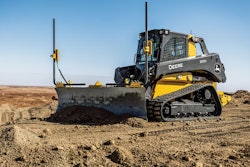
A&I-main-photoMyron Mullett’s gut told him there had to be an easier way. As owner of Westcliffe, Colo.-based Mullett Excavating, he had received a multiyear military contract to lay gravel on 90 miles of road in nearby Fort Carson. The 32-foot wide road, designed in part to handle tanks, required 4 inches of gravel on each side and a 2-percent crown. Mullett figured the tight-tolerance job would call for driving three rows of grade stakes: one on each side and one in the center. He wasn’t in the mood to drive all those stakes.

So he began to wonder: Would a box blade attached to the front of a dozer blade eliminate the need for stakes?

Well, no, everyone told him when he started asking around. He’d never be able to keep the gravel from going under the sides and throwing off the grade.

But Mullett still thought the idea had merit, so he tinkered with a snowplow blade, putting adjustable skids on each end, and then attaching it to an old dozer. He also put a plow device on each side of the blade that directed the gravel underneath the blade and away from the skids. Using the down force of the dozer, the skids rode on the subgrade, keeping the attachment at grade, allowing the blade edge to screed the gravel to grade as it passed underneath.

The make-shift set up worked, laying gravel at the required tolerances and maintaining grade, all without stakes. “Not only did we do the project faster, our end product was much better,” Mullett says.

Beyond a stakeless operation, Mullett had another impetus with his experimentation: accurate gravel placement. “If a contractor’s being paid for 8 inches of gravel, he only wants to put down 8 inches,” Mullett says. “Since this stays on the subgrade, if your subgrade is right, it will place the correct amount of gravel.”

Mullett knew he was on to something, so after the first job he created a from-scratch fixed 18-foot prototype his company still uses. “We tried to bury it in gravel to see how much we could do in one day, using 20 belly dumps and hauling three loads per hour,” he says. “We laid down almost 18,000 tons of gravel in 10 hours straight.”

These prototypes lead to AggreScreed, an attachment Mullett is marketing through his fledgling company, TerraTec Industries.


AggreScreed at a glance

Host machine: 125- to 200-net-horsepower dozer with straight, six-way blade

Attach/detach time: Up to 30 minutes

Width: 16 to 24 feet, extending in 1-foot increments

Height: 4 feet

Weight: 6,000 pounds

Depth of gravel: Up to 15 inches, adjustable at any increment

Crown: Up to 3-½ percent


One key to AggreScreed is its adjustability. The blade width, side skids and the blade edge are all adjustable. The width can change from 16 to 24 feet in 1-foot increments. In the 24-foot position, the attachment is capable of laying down gravel to spec, complete with a crown, in one pass down the middle of a standard two-lane road.

Mullet-credits

Mullet credits the plow device on each side of the blade as “the reason the whole thing works.” It keeps gravel from

AggreScreed’s width is adjusted by 24 bolts – 12 on each side – in a process that takes 40 minutes manually. Once the bolts are removed, the attachment’s hydraulic system, controlled by a box mounted in the dozer cab, extends or retracts the blade to a preset position. Reattach the bolts into the pre-drilled holes and you’re ready for the next job.

Adjustability turned out to be the biggest design challenge, since Mullett sought an economical solution that didn’t take a lot of time to change. Because the hydraulics are used only when adjusting the width and skid heights, Mullet used a separate hydraulic system for AggreScreed rather than tapping into the host dozer’s system.

“… between the decrease of labor and the accuracy of gravel placement, the attachment could be paid for after placing 10 miles of road.”

Myron Mullett

View Full Article
comments powered by Disqus
advertisement
advertisement
advertisement