


Applications and Innovations
Better Roads Staff
Mill-And-Fill Math
Making sure the numbers add up is the first step to a successful job
That mill-and-fill job up for bid may seem the exact boost your company needs right now.

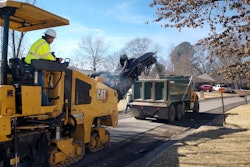
The biggest benefit for milling contractors today is flexibility of machine application, says Wirtgen America Senior Vice President Jeff Wiley. “Every job is different,” he says, “and the operator today has the opportunity to select the type of grade control system he wants to use.”
It may very well be, says Terex Roadbuilding’s John West, but there’s work to do before – or even if – you submit.
“Priority number one for the milling contractor,” he says, “you have to know what that aggregate is, in order to be able to envision what it’s going to cost you in carbide consumables and what you can project your daily production numbers to be.” A milling machine has 200-250 carbide tools, valued at about $4 apiece, he explains. “Now, are you changing those hourly or are you changing them daily? That’s a $1,000 to $10,000 variance daily. You can bid yourself right out of business here, just depending on what the severity of the aggregate is. You want to know what you’re up against before you get up against it.
“Normally, you’ll spend more on carbide tools in three years of ownership than you pay for the machine itself. It’s nothing for a contractor to spend $200,000 or $250,000 seasonally on a milling machine, just on carbide tools alone. If you can decrease that annual cost by 10 to 15 percent, that’s a huge number, particularly if you run a fleet of 10, 12 or 15 machines.”
Milling or cold planing generates recyclable or reclaimed asphalt pavement (RAP), which in turn can be used as aggregate base, stabilized aggregate base, cold-mix asphalt or new hot-mix asphalt, says Eric Baker, marketing manager with equipment manufacturer Roadtec.
On the milling side, says West, also to be considered before bidding are requirements for smoothness and pattern increasingly obligated by agencies to be tested and approved as prerequisites for project completion and contractor payment.
This will lead directly to the contractor’s cost-variable cutter pattern requirement, determined by the number of carbide teeth placed on the milling machine’s mandrel. Roadtec’s Baker explains from coarse to fine:
Excavating Pattern provides coarse 3/4-inch spacing, allowing a significant increase in production. This technique of “strip milling” is used where full-depth removal, up to 12 inches, is desired.
Traditional Pattern, with grooves spaced 5/8th of an inch apart, is the industry standard for asphalt overlay. Suitable for milling up to 8 inches in depth, it allows production with an acceptable temporary driving surface.
Profiling Pattern, described as a fine-textured version of the traditional pattern, requires more teeth on the drum for reduced spacing of 3/8th of an inch. Best used on cuts no deeper than 2 inches, the result is a surface suitable for driving, with or without fresh asphalt overlay.
And Micro-Milling, sometimes referred to as “carbide grinding,” is performed prior to a seal coat to re-establish profile, grade and skid-resistance or to “de-slick” flushed pavements. The typical pattern of 1/5th of an inch is best used on thin cuts of no more than an inch deep.
A smooth milled surface with the correct profile provides two major benefits for paving contractors, Caterpillar Paving Products reported in a recent New Hampshire and Vermont case study: the crew would be able to pave both lifts using grade control on both sides of the paver, thus avoiding smoothness-losing profile built with slope control; and total smoothness improvement would not confined to just the leveling and wear courses.
“Milling contractors are entering an era now where the word ‘milling’ needs to be thought more of as ‘profiling,’” says West, Terex Roadbuilding product support specialist. “Regardless, you have to have weight, horsepower and grade control in order to maintain a productive balance. You just can’t take an undersized machine, place it on an oversized task, and expect a happy result.”
MORE FROM Applications & Innovations
MORE STORIES
POPULAR
COLUMNS
BLOGS
- Sydney uses water curtains to alert drivers to stop (VIDEO)817 Views
- Obama signs memorandum to expedite infrastructure projects625 Views
- Florida’s Red Light Camera Game: G R E E N orange R E D330 Views
- Big four cellphone companies jointly launch anti-texting campaign267 Views
- Acceptance of connected vehicles depends on cost, LaHood says258 Views